Aircraft Spotlight: The Bombardier Challenger 650

When Bombardier unveiled the Challenger 650 in 2015, it wasn’t pitched as a radical rethink of private aviation. Instead, it was framed as the latest stage in an ongoing process of refinement - the culmination of decades of lessons learned, incremental improvements, and steady adaptation to the demands of a changing marketplace. Today, the 650 stands as one of the best-selling large business jets, balancing performance, passenger comfort, and cost efficiency in a way that has helped it carve out a loyal following among corporations, charter operators, and high-net-worth individuals.
From Bill Lear’s Vision to Bombardier’s Flagship
The story of the Challenger series begins in the late 1970s with Bill Lear, the aviation pioneer responsible for the iconic Learjet. Lear envisioned a wide-body business jet that would redefine comfort for private travellers. Unlike the narrow-cabin designs of the time, the Challenger 600 offered passengers space to move around, stretch out, and work effectively while in the air. It was a bold concept - but not without its flaws.
Early versions of the 600 suffered from reliability issues, particularly with the engines and fuel efficiency. Critics questioned whether the aircraft could compete against rivals from Gulfstream and Dassault, who emphasised speed and range over cabin comfort. Yet Bombardier, which acquired the programme in 1986, continued to invest in the line. With the Challenger 601 and 604 models, improvements in avionics, aerodynamics, and engines gradually addressed the early missteps, turning the aircraft into a credible, long-range contender. By the time the Challenger 605 arrived in 2006, the series had established itself as a mainstay in the corporate jet market.

The Challenger 650 Takes Shape
The launch of the Challenger 650 in 2015 represented a strategic moment for Bombardier. While rivals such as Gulfstream’s G450 and Dassault’s Falcon 2000LXS were competing in the same segment, Bombardier positioned the 650 as the most cost-effective choice. Equipped with General Electric CF34-3B engines, delivering greater thrust than its predecessor, and a Honeywell avionics suite with advanced synthetic vision and improved situational awareness, the 650 enhanced both performance and safety.
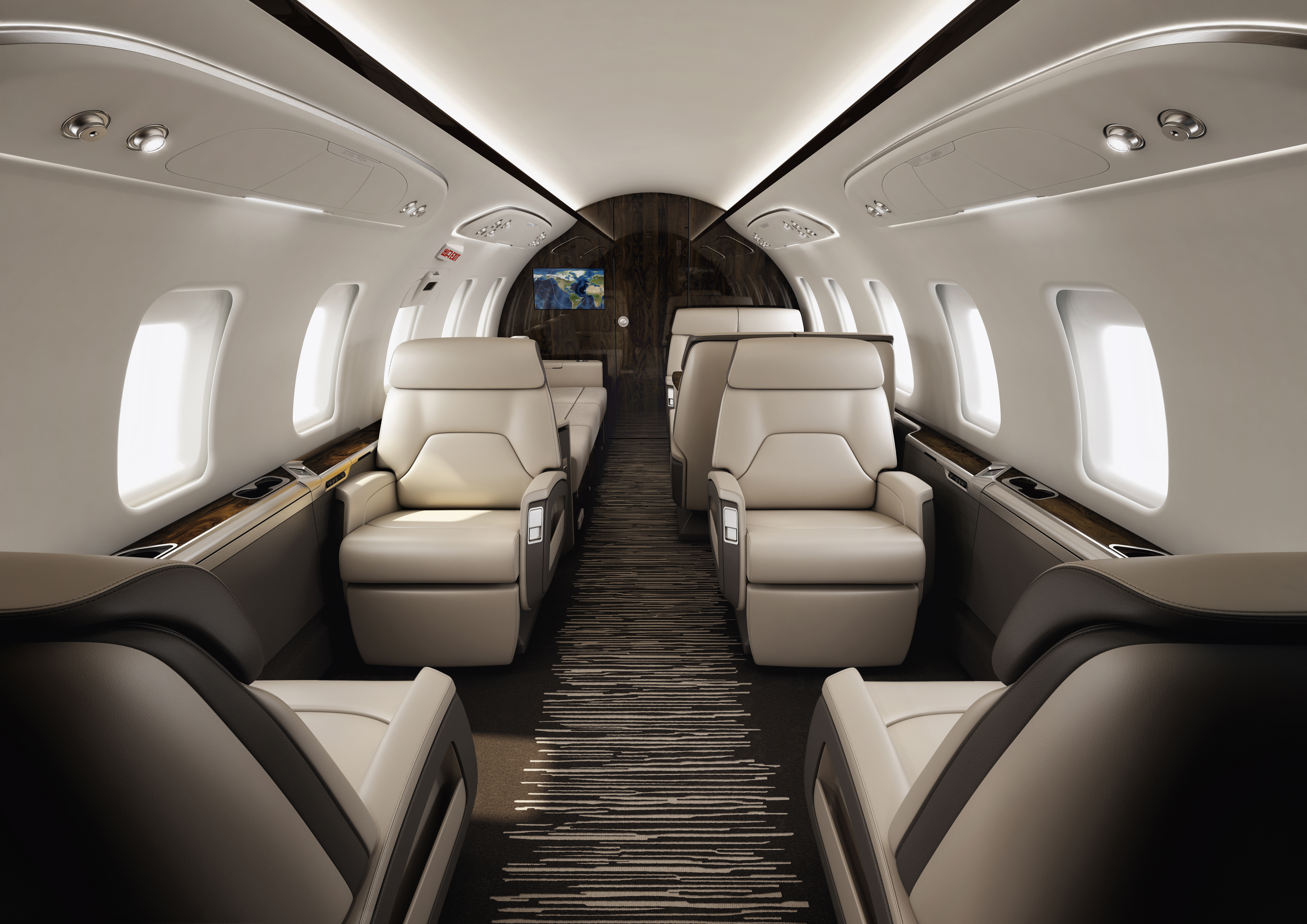
Inside, Bombardier placed an even stronger emphasis on passenger experience. The cabin, one of the widest in its class, can be configured for up to 12 passengers and includes lie-flat berths for five. Noise reduction technology, bespoke materials, and connectivity upgrades, including high-speed internet and advanced entertainment systems, reflected the new reality of business travel, where executives expect to remain productive in flight. David Coleal, then-President of Bombardier Business Aircraft, summarised the company’s approach at the launch: “The Challenger 650 provides the best value proposition in its segment. It delivers on comfort, performance, and cost efficiency.”

Range and Performance
One of the Challenger 650’s most notable features is its range, roughly 4,000 nautical miles. This capability allows for non-stop routes such as New York to London or Dubai to Singapore, itineraries that have become benchmarks for long-haul business travel. The aircraft is also certified for steep approaches, enabling it to access airports that are typically more challenging for large jets, such as London City, Aspen, and Lugano.
Another strength is its ride quality. Bombardier has long promoted the Challenger wing design as delivering a smoother flight experience, something that frequent transatlantic travellers appreciate. This combination of performance and comfort has allowed the 650 to carve out a niche with operators who require both flexibility and reliability.
Adoption Beyond the Boardroom
The Challenger 650 has proved popular not only with private owners and corporations but also with specialist operators. Swiss Air Ambulance (Rega), for example, selected the model for its long-range medical evacuation fleet. The aircraft’s cabin dimensions and extended range make it particularly suitable for carrying both patients and critical care equipment across continents. This dual use highlights one of the Challenger’s enduring strengths: its ability to serve in both luxury and mission-critical roles.
On the private ownership side, the 650 has found favour with high-net-worth individuals seeking a balance between prestige and practicality. While some ultra-wealthy clients gravitate towards larger aircraft such as the Gulfstream G650 or Bombardier’s own Global series, many appreciate the Challenger 650’s ability to deliver long-haul performance at a lower operating cost.
In business aviation, prestige often comes at a high price. Yet Bombardier has consistently emphasised the Challenger 650’s operating economics as a key selling point. Independent analysts note that its direct operating costs are among the lowest in its category. For corporate flight departments and charter operators, this has made the 650 a financially viable option, particularly in a market where efficiency is increasingly scrutinised.

A Legacy of Incremental Progress
What stands out about the Challenger 650 is not a single revolutionary feature but the cumulative effect of decades of refinement. From Bill Lear’s early sketches to Bombardier’s modernisation of the platform, the aircraft embodies an evolutionary design philosophy. Each iteration has improved upon the last, addressing earlier shortcomings and incorporating new technology without abandoning the core principle of cabin comfort.
This approach has ensured that, more than 40 years after the Challenger first entered service, it remains a cornerstone of Bombardier’s business jet line-up. For many operators, the 650 hits a sweet spot: large enough to handle intercontinental travel, versatile enough for more challenging airports, and cost-effective enough to make financial sense in a competitive market.
The Bombardier Challenger 650 may not grab headlines in the same way as some of the larger, flashier jets, but its story is one of persistence and refinement. As business aviation looks to the future, the Challenger 650’s balance of performance, comfort, and economics ensures it will remain relevant - a testament to the enduring value of constant evolution. For more information contact info@flyvictor.com