A Family Journey to the Edge of the Arctic
Luminaire founder Adam Sebba documents an extraordinary family escape through Norway’s Lofoten Archipelago
When travelling solo, on business, I am the guardian of my passport and boarding pass. Today I am with my family, so my highly organised wife insists on carrying the entire packet. Although intended as a favour, I feel a little naked, stateless, wandering through the airport without documentation. And so, without papers, slightly anxious, I arrive in Norway.
I’m looking for a journey, not a holiday for the four of us; my wife and two young children aged 8 and 6. We are determined to explore the Lofoten Archipelago together and reach the most westerly point (next landfall Greenland) spending three days on Litløya - an island with a circumference of about 1.2 miles - where we will stay in a decommissioned lighthouse, now a unique boutique hotel. The island has been inhabited for 6,000 years, with written records dating from the mid 1400’s. Yet by the 19th century only about 250 souls lived here. Dried fish was hard currency.
But to work our way there takes time. We start in Naustholmen, guests of Randi Skaug. Randi has summited Everest, was the first Norwegian woman to climb the seven summits. Her chef and Sherpa, Tandjin is supremely overqualified for the role of chef at sea level, having topped out Everest twice already and cooked for clients at camp 3. Effortlessly, he produces a spiced sweet potato soup for us on arrival. Randi’s menu spans continents and maps her explorations. The sweet potato is from Aconcagua.
Randi’s Island Hotel, reached by motor-boat from the local ferry port, feels remote, and historic. A trading post since the 1600’s, it’s a protected inlet that has seen sail and steam with catamaran ferries, trading in cod, skins, dried fish, timber/lumber, and now tourists.
She has a no-menu approach to dining. With our under 9’s used to ‘children’s menus’ it’s refreshing to see them simply presented with food and expected to get on with it. We are nervous 21st century parents, but they are hungry and devour it. Since we are on an island with no shops there is no alternative – and they know it. Naustholmen is every parent’s dream for children’s meals, a certain cure for fussy eaters; guaranteed results after one week.
Next on the activities menu is climbing; used to London urban climbing walls, this is the children’s first taste of real rocks. We scramble up to a crag and our instructor shows us how to attach harnesses. He scrambles up like a mountain goat almost dancing back down the cliff with the rope secured at the top. Our children try - and succeed. The crag is perfectly chosen so that it is stretching but achievable, building their confidence. We fill the remaining days with kayaking, hiking, and endless circuits in the sauna, strategically placed above the bracing waters. We alternately cook and then ice ourselves; even our 8 year old daring to dip and swim in the dock. He is very proud of himself.
From Naustholmen, the Vikings would travel west to Lofoten - if they could see a twin jagged peak on the other side. The aiming mark for a seafaring people. And so too it is time for us to go west on our family adventure. We can see the aiming mark; so we head off, albeit by motor boat, ferry and propeller plane. Faster than a longship and just as exciting.
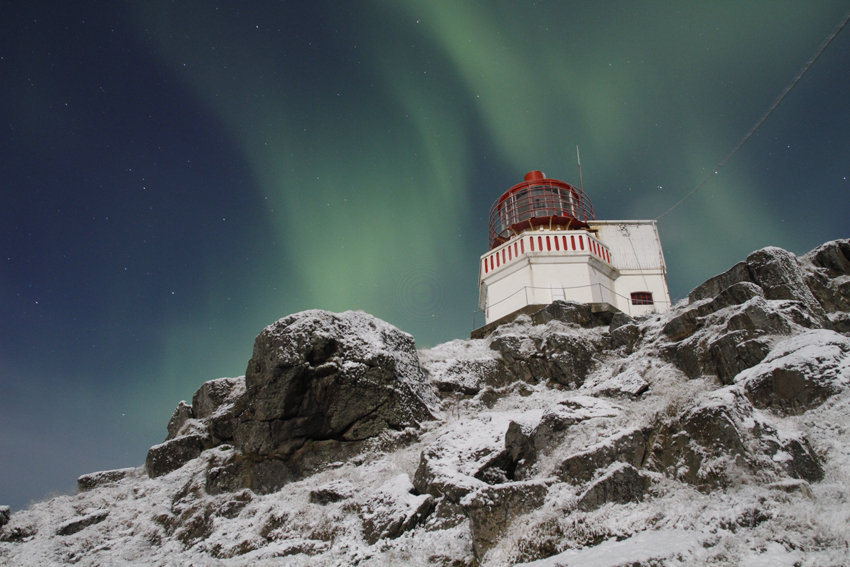
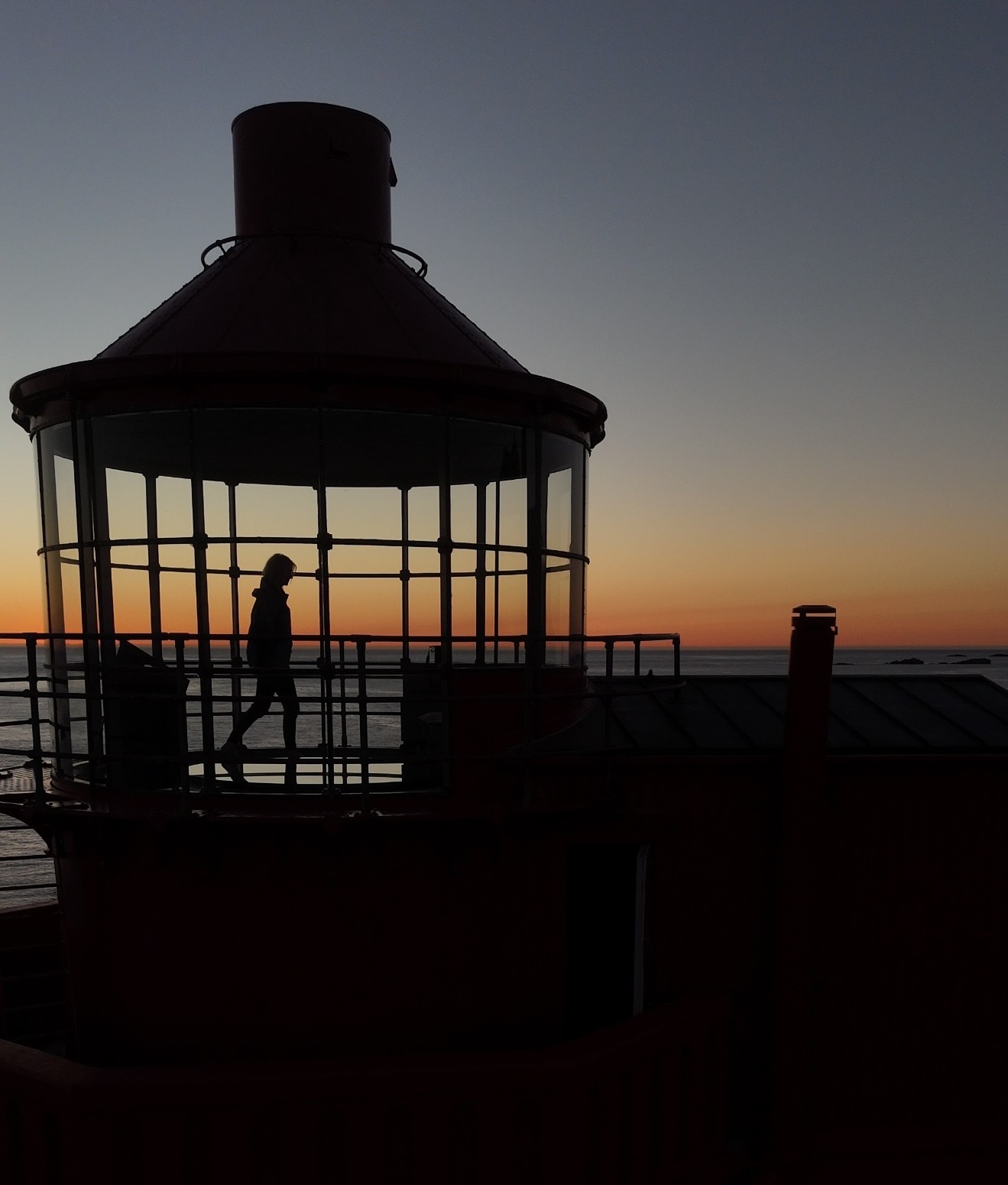
We journey from Stokmarknes then to Bø. People often talk about ‘a sense of place’ but perhaps you have to travel somewhere like Bø to really understand what that means. The sense here is truly that of being on the edge of the world; as our RIB speedboat transports us to the Littløy lighthouse.
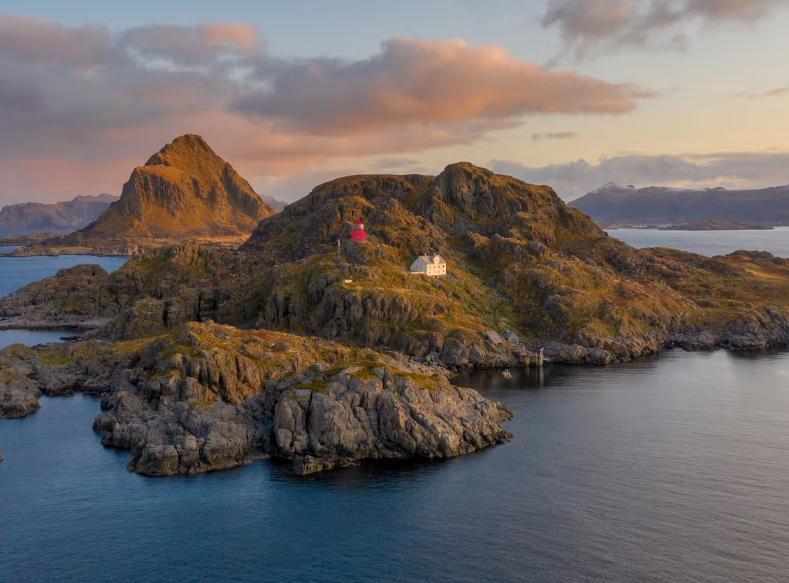
A picture book fire-engine red lighthouse comes into view as we round the corner gasping. This stunning sight turns us all into children again. Littløy Fyr, run by a unique hotelier, Elena, the lighthouse keeper, is jaw droppingly beautiful.
Elena, with her steel grey hair, black polo neck, round-rimmed glasses and black beanie, could easily pass for a detective or spymaster in a Skandi noir (film). On the island, she wears many hats; RIB driver, fishing host, wildlife guide, sometime chef (although the kitchen is mainly run by an accomplished French Chef, Renaud) With a clear eye for Skandi chic interiors, she has overseen the transformation of the historic building rom working lighthouse station to an uber cool getaway; petrol blue and battleship grey interiors and a library stocked with Ibsen, Shakespeare, and Rushdie.
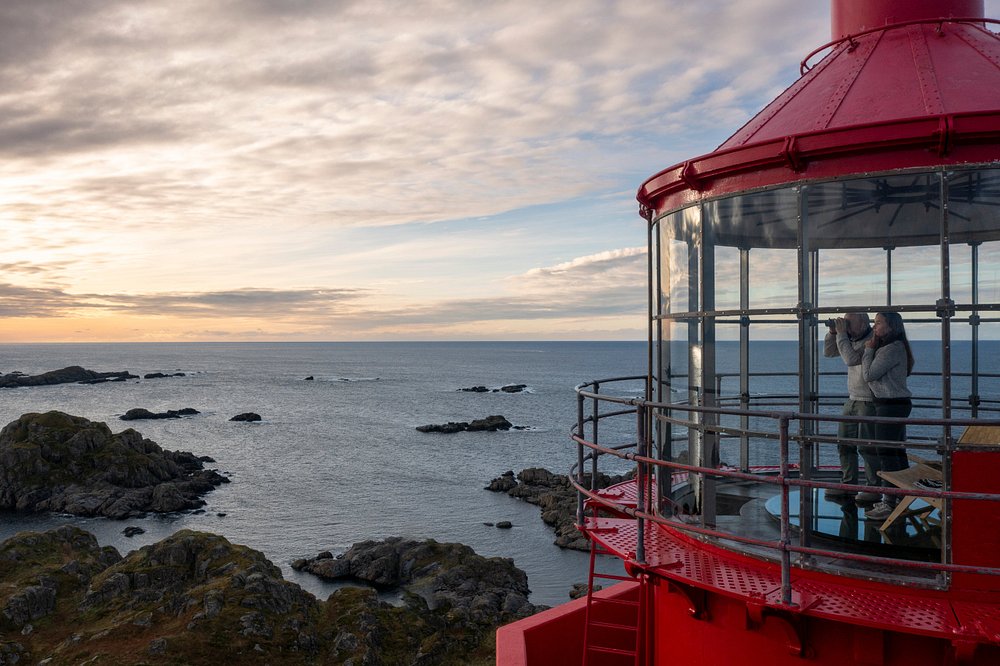
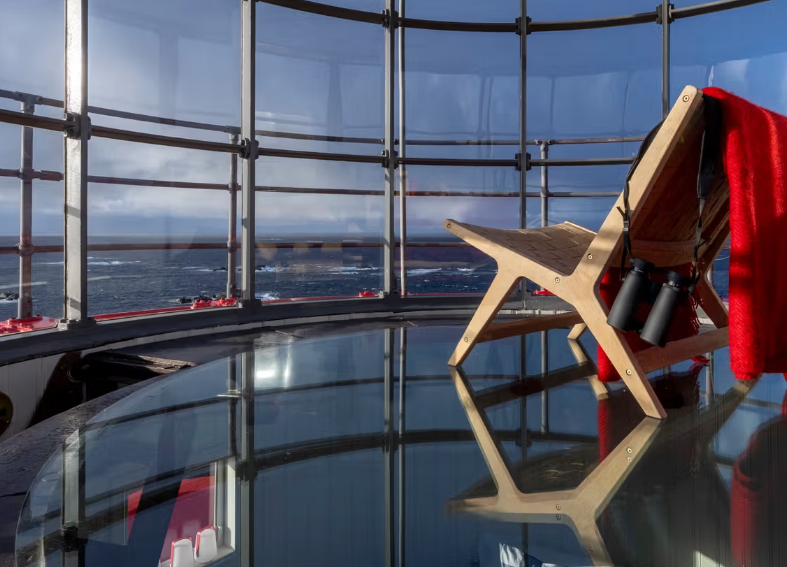
One gets the impression that this is Elena’s authentic and personal collection, not the curated library that many hotels seem to buy in as a statement of interior design. Modern wood-burners, handmade Swedish beds and wet rooms are how the lighthouse keeper’s suite are designed; topped with magnificent views across the Lofoten Peninsula, probably stretching over 40 miles. When Elena describes hand-made Swedish beds, it’s clear that she does not mean IKEA - which is what that phrase would probably mean in many UK households. But the lighthouse itself is the crown jewel. Original 1912 cast iron features with spiral stairs to a bedroom suite; itself with a glass ceiling, and the glass dome of the lighthouse itself.
As you lie in bed, you are the filament of the bulb that lit the way for vessels of the 20th century. Now no boats. The scenery is devoid; no trawlers, frigates, cruise ships or oil tankers; we have this corner of the planet to ourselves.
Before we travelled, we were apprehensive about spending three days on a small island with two children. Would we go Ben Gunn style mad; or at least get mad at each other? It was soon apparent how wrong we were with activities including kayaking, hiking around the island and eagle spotting all on offer. But time speeds up at that latitude. Even with daylight until 10 and dawn at 5, the long days are easy to fill.
On the first day we hike the neighbouring island. History runs deep, with stone age settlements, and church-run fishing operations in the 1400’s. The last people moved away in the 1950’s after running water and electricity was introduced to the nearby mainland. The few folk picked up their timber houses and moved them, in entirety, across the channel.
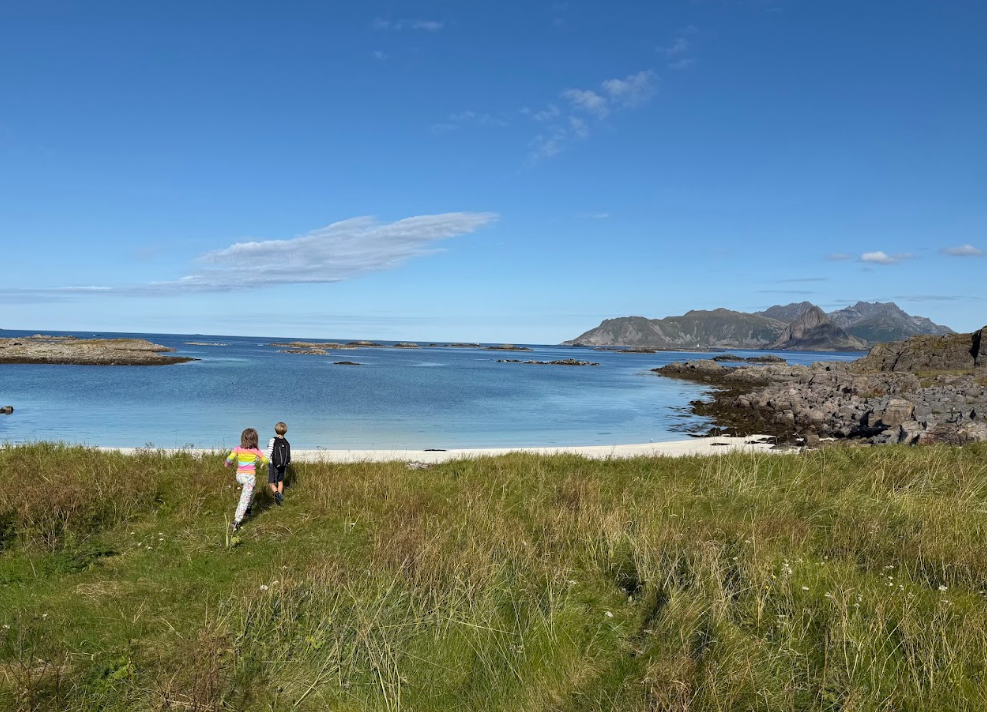
We traverse a coastal ‘path’ - overgrown and adventurous until we reach a white sandy beach. It is Maldivian white sand a picture book beach but without any other tourists. The water is clear, but bracingly cold. I can swim, without masochism or machismo, for just eight minutes. But all of us take in the Arctic sun from the beach in swimming costumes for an hour and a half. We are warm, and sunscreen is applied. We are in the Norwegian Sea or Arctic Ocean; around the corner is a salmon farm. It hardly seems possible.
On the way back, we see a white tailed, or sea eagle. Its majestic wingspan is impressive. This sighting is a powerful family bond. None of us have ever seen an eagle in the wild before today. Now we all have.
On our return, Elena’s chef, Renaud, has whipped up a storm in the kitchen. Pan fried fish, mashed potato with seaweed. It is a buttery, salty, glorious dish. The dining room has views across the bay, front row seats to a sunset extravaganza of pinks, blues and yellows, gradually changing across the sky. We keep our eyes peeled in the waters below for mythic whales, or orcas. ‘They often come across the bay.’ Elena comments ‘only, they don’t let us know in advance,’ she adds in lilting Scandinavian tones.
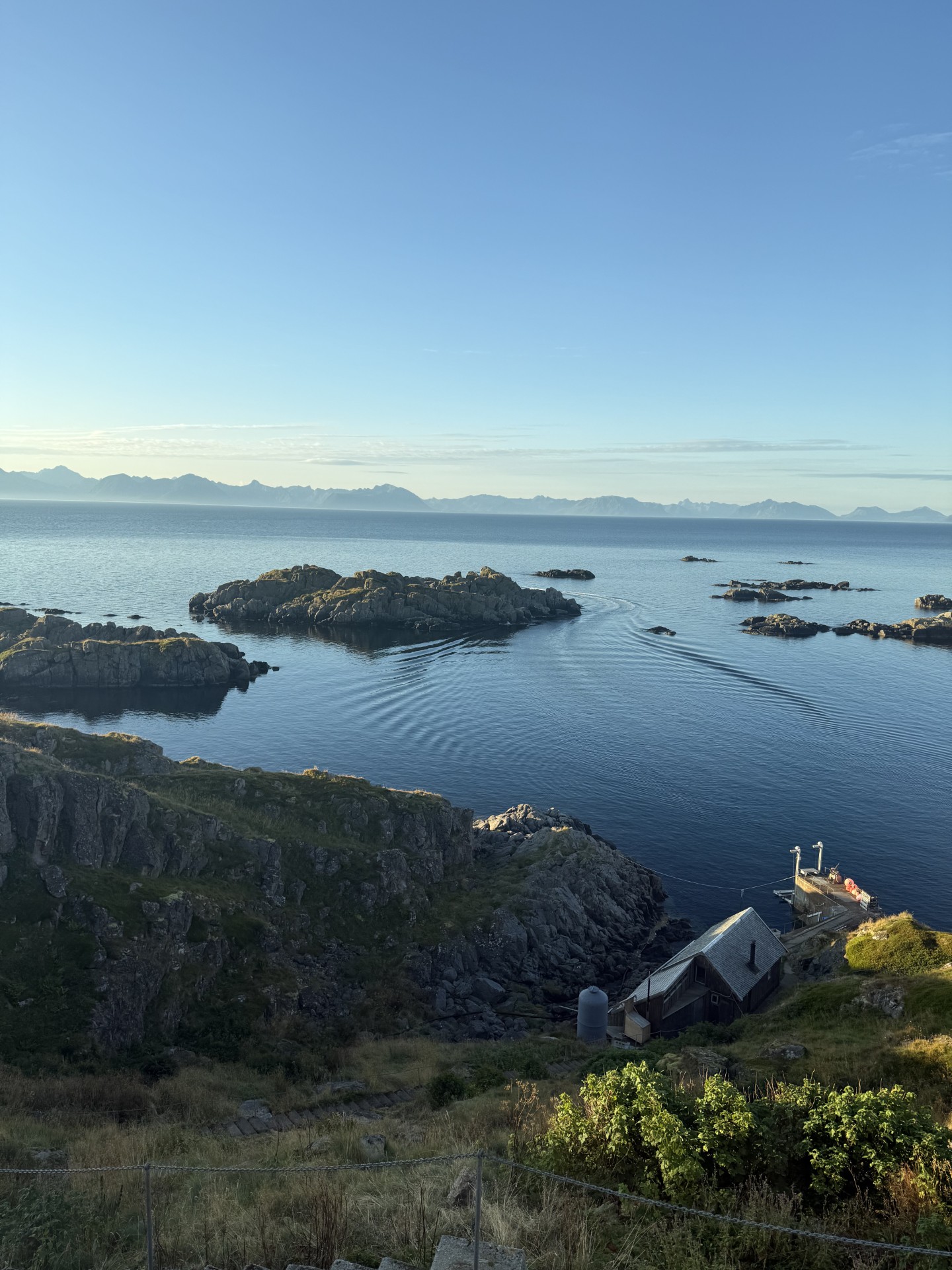
The next day, we go seal spotting in the morning and then I head off for a long run. lunch is fish burgers and lettuce. By now, used to the no menu policy, which seems to be a universal Norwegian thing, our children even eat the lettuce, scarcely commenting. My wife and I exchange silent glances. Sam, aged 8, comments ‘we must eat all the food as they’ve brought it out here to the light house especially’. This is magnificent and highly unusual. We play chess, the children paint in the sunlight. We all just bask in a life so different.
I have a hankering to fish. I have never fished before. But people on this island have fished for 6,000 years and now seems a good day to start. I persuade my son to join, and we leave my daughter and wife behind on the island. Whilst willing to consume fish, she is reticent to be a willing participant in, or even a witness to the moment that a fish ceases to live and becomes a consumable. Fair enough. Elena takes the two of us out in the Rib; within 5 minutes we’ve seen an Eagle on the hunt, and a seal, curiously looking at us. This is an auspicious start.
After 30 minutes of fishing, we’ve caught two mackerel. Both get away, or was it the same one? I catch a pollock. We don’t weigh it but it must be enough to provide a starter for a family of four. Then my rod strains. This time it’s a cod and feels very much like a 7kg dumbbell. As we haul it into the boat, we hear a sound behind us.
Just 50 metres away, a Humpback whale breaches! This must be a probability of 1 in 10,000 or 100,000. How many times would you have to go out in a boat for a whale to coincidently come up next to you? We watch, whooping with joy, as it puts on a show, breaching again before flicking its tale, and diving down again. Our white whale has come, providing a fitting end to a memorable family journey that proved to be much more than ‘just’ a holiday.
For more information contact: concierge@flyvictor.com